
Entering the Bathtub Factory: A Concerto of Metal and Temperature
The moment one steps into the bathtub factory, the sense of industrial order and the warmth of life interweave into a picture before one's eyes. On the iron-gray exterior walls of the factory building, climbing plants are quietly climbing up, creating a wonderful balance between the greenery and the coldness of the metal. Pushing open the heavy soundproof door, the roar of machinery and the soft rustling of metal are no longer noisy; instead, they compose a concerto about craftsmanship. Here, it is the intersection of industry and life, the place where cold hard metals meet warm flowing water.
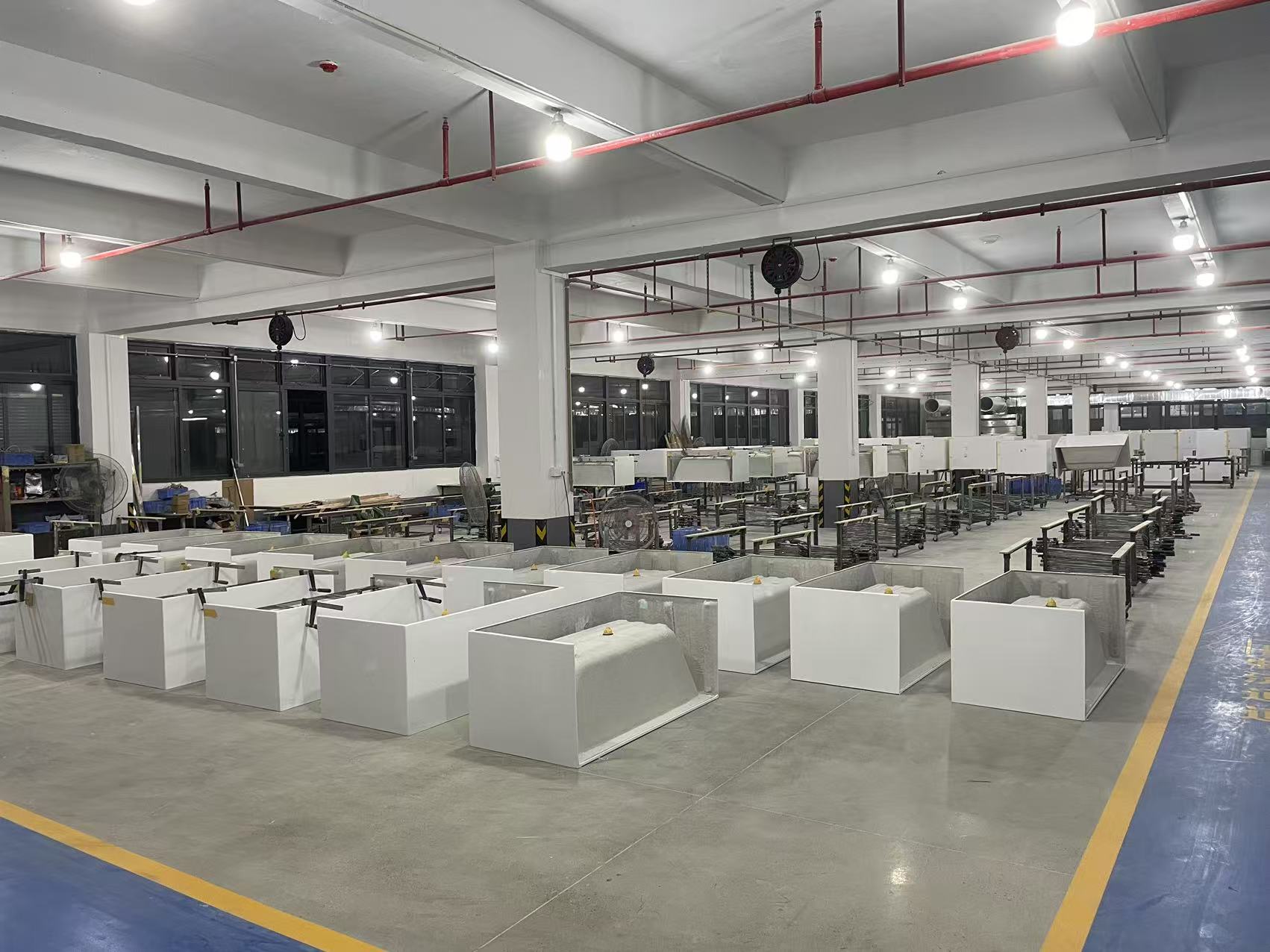
The first area that catches the eye is the mold zone. Rows upon rows of huge molds are neatly arranged, like sleeping giants, with their surfaces covered in fine release agents, giving off a soft matte glow under the light. The outline of the mold is not a simple straight line or arc, but rather the result of countless ergonomic calculations by the designer. Each curve precisely conforms to the natural curvature of the human spine, as if it were a collaboration between nature and human wisdom. The workers, dressed in blue work clothes, moved among the molds with such dexterous movements as if they were dancing a mime. Some held rollers and evenly applied the mold release agent to every inch of the mold's curvature. Where their fingertips passed, it seemed as if they were laying the foundation for a work of art. Someone is calibrating the gaps of molds with precision instruments, their eyes focused as if they were restoring precious cultural relics. The gap of the mold was calibrated to an accuracy of 0.01 millimeters, as even the slightest deviation could significantly reduce the load-bearing capacity or comfort of the final bathtub. The "breathing" of these molds - the feeding channels and the exhaust gaps - have all undergone fluid mechanics calculations to ensure that the slurry can flow evenly without any dead corners.
Passing through the mold area, the scene of the raw material blending area is even more tech-savvy. The huge mixing tank rotates slowly. Inside the transparent observation window, resin, curing agent and mineral fillers are being evenly mixed. The slurry presents a fine milky white color and flows slowly like melted cream. The data flickering on the control screen is a carefully formulated "recipe" by technicians - temperature, proportion, and stirring speed. Each parameter is related to the strength and texture of the bathtub. Engineer Li pointed at the curve on the screen and explained, "The ratio of resin to curing agent must be precise to two decimal places, and the temperature deviation cannot exceed ±1℃; otherwise, the hardness or toughness of the bathtub will be affected." Even a 0.1% difference in the proportion could cause the bathtub to develop fine cracks one day in ten years. His fingertips swept across the screen, his eyes brimming with awe for quality. There is no magic here, only science: quartz powder increases hardness, aluminium oxide enhances wear resistance, and a trace amount of colorant gives the bathtub a warm and smooth texture like jade after it is formed.
The pouring process is the most ceremonial moment. The robotic arm precisely injects the slurry into the mold. The slurry flows slowly along the edge of the mold, filling every tiny corner. Workers hold scrapers and gently trim along the edge of the mold to ensure uniform thickness. The moment the mold closes, the "sizzling" sound of air being squeezed out of the gap is particularly crisp, as if a silent contract is being fulfilled. Subsequently, the mold was sent into the constant-temperature curing furnace. The moment the furnace door closed, it seemed as if the anticipation was sealed away - temperature and time acted quietly inside the furnace, allowing the flowing slurry to gradually solidify into the shape of a bathtub. Inside the curing furnace, the temperature curve is like a carefully composed symphony: from low-temperature preheating to high-temperature cross-linking, and then to slow cooling, every step is strictly controlled. It can't be rushed; otherwise, stress will be generated inside the material. We can't be slow; otherwise, production efficiency will be affected. This is a dialogue with time. Only by waiting patiently can the material undergo a transformation from "soft" to "hard", from the tenderness of liquid to the tenacity of solid.
Stepping out of the curing area, the rustling sound of the grinding workshop immediately filled my ears. The bathtub has been taken out of the mold, and its exposed surface still has a slight roughness. Workers held sandpapers of different mesh sizes, grinding the surface layer by layer from rough grinding to fine polishing. Someone squatted in front of the bathtub, their fingertips gently brushing the edge, feeling the changes brought by each polishing. Some people shine a strong light on the surface to capture possible minor flaws in the interplay of light and shadow. At the quality inspection counter, Master Zhang, an experienced craftsman, held a magnifying glass and inspected every detail of the bathtub inch by inch, not even missing a tiny bubble as small as a needle tip. His rough fingers streaked across the surface of the bathtub, just like an old lute player stroking a string: "The bubbles may seem tiny, but over time, water vapor seeps in and forms dark spots." A bathtub will accompany a person for over a decade and cannot afford the slightest carelessness." His words were simple and plain, yet they were filled with respect for the users. Polishing is not only about removing blemishes but also endowing the bathtub with a skin-like touch - the sandpaper is changed from 240 mesh to 2000 mesh, and the surface gradually transforms from a matte feel to a mirror-like smoothness, with a pearl-like luster flowing under the light.
The pace in the packaging area has become lively. The polished bathtub was carefully wrapped with anti-scratch foam, then covered with a waterproof film, labeled with production information, and neatly stacked on a wooden pallet. The forklift moved slowly, transporting these "finished products" to the warehouse. Packaging worker Xiao Chen, while skillfully wrapping the protective film, said with a smile, "The packaging of each bathtub should be as meticulous as wrapping a dowry. Even if it gets bumped, it won't do. People buy it and put it in their new homes." Through the warehouse window, I saw boxes of bathtubs waiting to be transported to various places - they would enter different families, become a haven when tired, a witness to parent-child time, and a private space when alone. Some bathtubs will be sent to high-end hotels to welcome guests from all directions in the presidential suite. Some will appear in ordinary apartments, carrying the warm daily life of a family of three.
When leaving the factory, the setting sun was gilding the building with a warm golden hue. Looking back at this seemingly cold factory, I suddenly realized that those metals and resins that seemed hard had already taken on warmth in the hands of the artisans. A bathtub is not merely a bathroom product; it is also a carrier of a lifestyle - it embodies people's yearning for comfort, cleanliness and privacy, as well as their deep definition of "home". And this factory, with its precise craftsmanship, rigorous attitude and warm dedication, has turned this aspiration into reality. From raw materials to finished products, from cold metal to a warm harbor, every detail of the bathtub factory tells a story about "dedication". This is the most beautiful encounter between industry and life, the blending of coldness and warmth, and the resonance of rationality and sensibility.
